

Knowing how to calculate yarn yardage for knitting or crochet is such a necessary skill. This is especially useful if you’ve lost the yarn label or if you purchased discount yarn that didn’t come with a ball band. How frustrating!
Don’t worry. I’m going to show you how to estimate yarn yardage in two different ways in quick easy steps. I’ll also include instructions for both Imperial and metric calculations (inches/centimeters and yards/meters).
Ready? Let’s jump right in.
Table of Contents
What You Need to Calculate Yardage in Yarn
For this tutorial on how to estimate yarn yardage, you’ll need a few things. First, you’ll need the yarn that you want to measure, obviously. It helps if it’s in yarn hank form so you can measure the length. If it’s not, you can either wind it into a yarn hank using a yarn swift, or you can use the second method, which I’ll cover later on in this post.
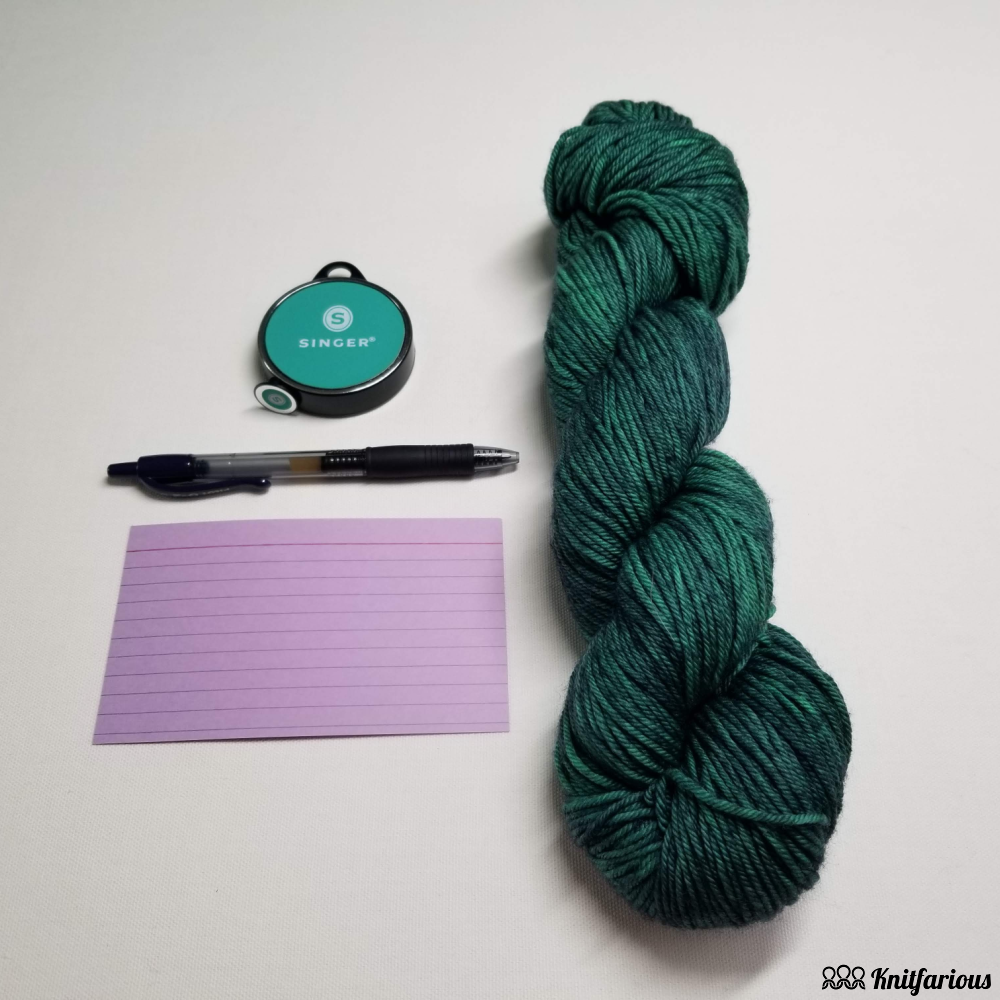
I’m purposely using my own hand dyed yarn to show you how the yarn yardage measurements compare to the original measurements. This will be beneficial for when we talk about the second method to estimate yarn yardage later on.
Second, you’ll need a flat surface to measure the full length, a ruler or a measuring tape, and a calculator. Third, I recommend that you use an index card and a pen to write your measurements so you can save it with the yarn. This way you don’t have to measure the yarn again.
Shown here is Wayback Yarns DK 250 SW (100% Superwash Merino Wool in Sea Glass colorway. For the Yarn Calculator Method 1, I’m using a Singer retractable measuring tape, a colored index card to write down my notes, and a Pilot G2 pen. For the second method, you’ll need a scale to weigh grams instead of a retractable measuring tape.
Here are the tools I used for Method 1:
Colored Index cards.
Singer Measuring Tape.
Pilot G-2 Gel pens.
Now, let’s talk about the first method of calculating yarn yardage.
Method 1: Measuring Yarn Length
This first method requires some basic math but it’s totally doable. I’ll even include the formula so you can easily understand the steps involved.
Alright. Deep breath. Here we go.
First, open your yarn hank and lay it on a flat surface in a straight line. Do not cut the ties that secure the yarn ends together. This will keep it from tangling.
Smooth the yarn hank out so it’s as flat as possible. Now, measure the length of the yarn hank from end to end with the measuring tape.
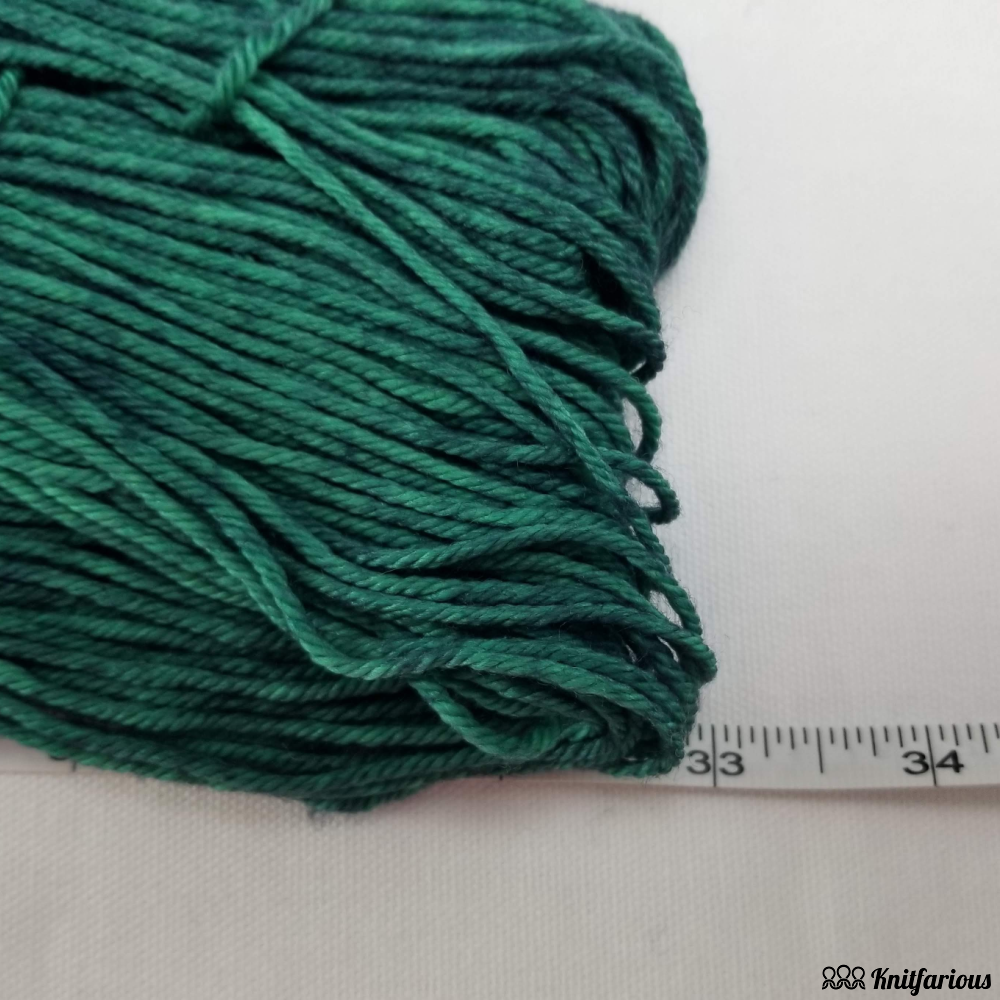
Using the aforementioned yarn, you can see that my length of yarn measures 33 inches (84 centimeters). Write this number down on your index card.
33 in / 84 cm= ½ the length of yarn skein
Note: This number represents half the length of your skein because you’re only measuring one side of the hank.
Next, count the number of strands on one side of the hank. As you count, I find it helps to separate the strands from the counted and the uncounted so you don’t get mixed up and have to start over again. Ask me how I know this.
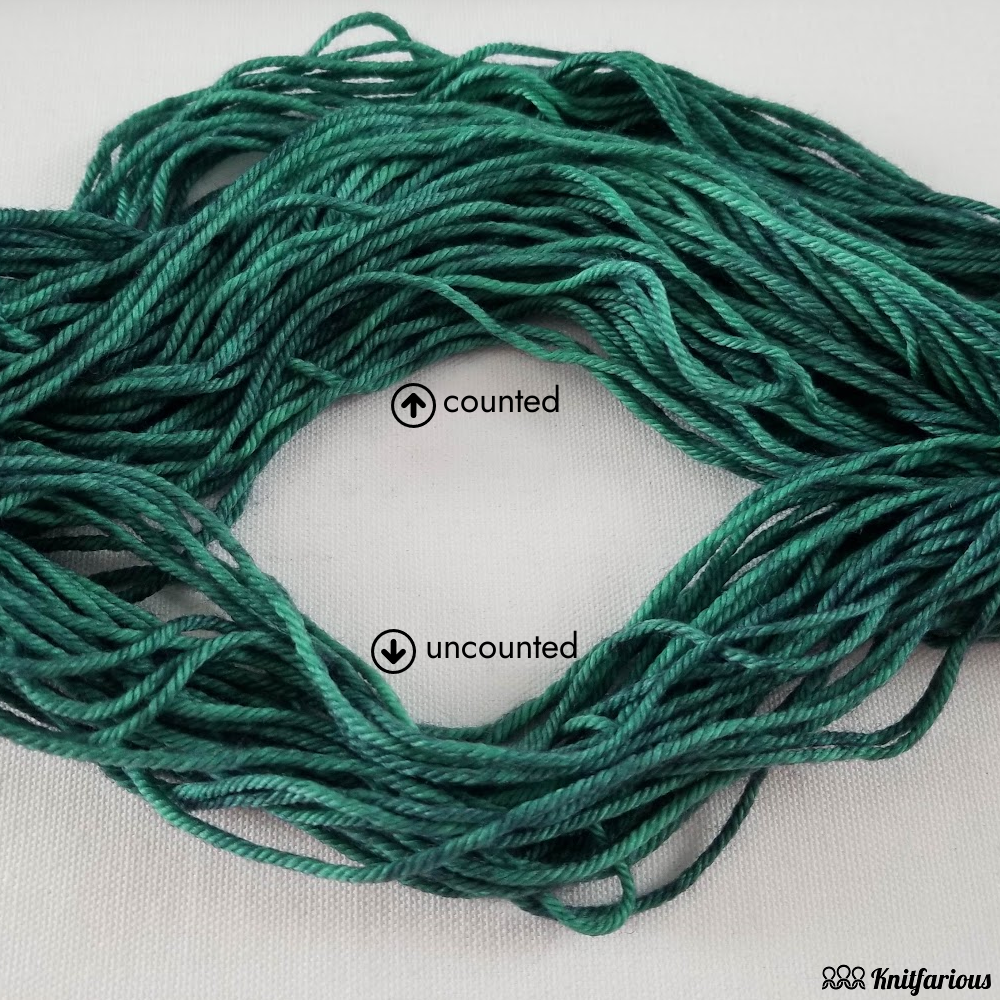
Once you’ve counted them all, write this number down on your index card. My count for this yarn hank is 119 strands.
119 strands of yarn in hank
Calculating Yarn Length for Method 1
Now, take the information from your index card and get ready to use your calculator. You can use the one on your phone, desktop, tablet, or use an online app.
Using my measurements, here’s how to determine yardage.
In this example, the length of my skein roughly measures 33 inches and I counted 119 strands total. So, this is how you calculate the length:
First, multiply the length of half of the hank by 2 to get the circumference of the yarn. You multiply the length of yarn by two because you measured only one half of the yarn.
Length of hank X 2 =
33 in X 2 = 66 in
84 cm X 2 = 168 cm
Second, you’ll need to convert the number of inches to yards or centimeters to meters. I used this online converter to assist me. For Imperial measurements, remember that there are 36 inches in 1 yard so you’ll divide 66 inches by 36. For metric, there are 100 centimeters per 1 meter so you’ll divide 168 cm by 100.
Convert inches to yards or centimeters to meters =
66 inches / 36 = 1.8333333333 yds
168 cm / 100 = 1.68 m
Now, take the number of strands (119) and multiply by 1.83 yds or 1.68 m
Number of strands X yards or meters
119 X 1.83 yds
119 X 1.68 m
This will give you the estimated yardage or meterage in your hank of yarn. Using my example, the results are:
Strands X yards or meters
119 X 1.83 yds = 218 yards (approximate yardage)
119 X 1.68 m = 200 meters (approximate meterage)
Once you’ve finished your calculation, write everything down on your index card. I like to then punch a hole and clip it to the yarn with a stitch marker. This way I won’t have to repeat the process when I finally want to use the yarn.
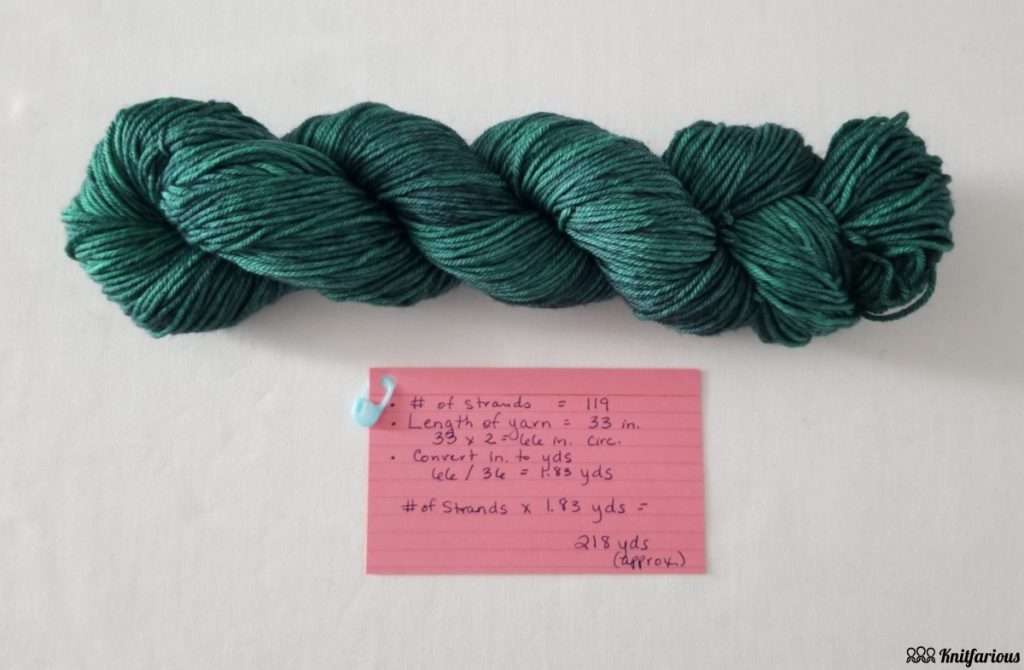
As I mentioned earlier, this is an estimate of how much yarn you have. The result hinges on measuring yarn length, which is difficult in hank form. However, it’ll at least give you a minimum measure of yarn that you have to work with.
Now, let’s talk about the second method of calculating yarn yardage or meterage.
Method 2: Weighing Your Yarn
This method is perfect for measuring scrap yarn, yarn leftovers, or any yarn that’s lost its ball band. I also find it to be useful for checking to see how much wiggle room you have in a full skein so you don’t end up playing yarn chicken. This will make more sense as we go along.
For this second method of calculating yarn, you’ll need to know the yarn brand and yarn base for a more accurate result. I’m using my brand of hand dyed yarn, Wayback Yarns in DK 250 SW yarn. The original weight of my DK weight yarn is listed as 250 total yards and a weight of 115 grams.
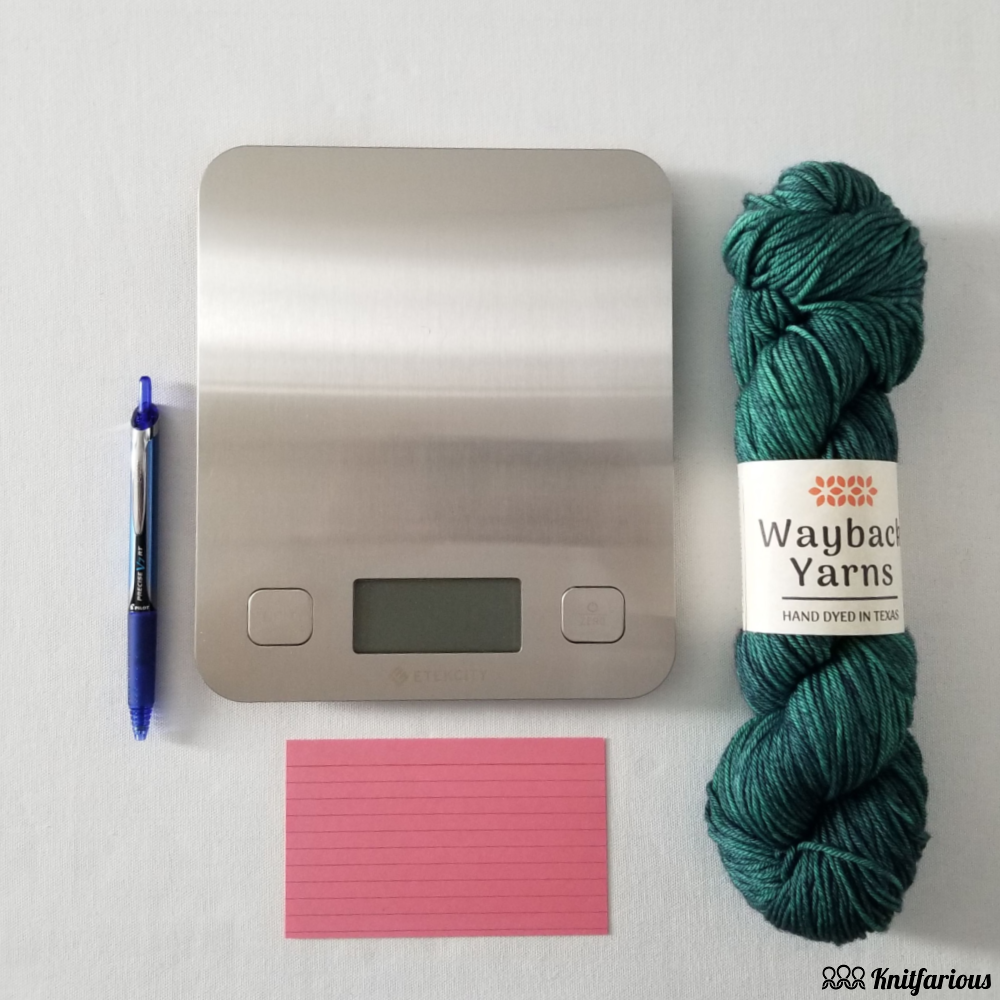
Additionally, you’ll need your scale, a new index card, and your yarn. It doesn’t matter what form your yarn is in (skein, hank, ball, or yarn cake) since you’ll just be weighing it on the scale.
Here are the tools I used for Method 2:
Colored Index cards.
Pilot Precise V7 RT Retractable pens.
Wayback Yarns DK 250 SW yarn in Sea Glass colorway.
Calculating Yarn Yardage for Method 2
As you can see, I’m using the same yarn as in the earlier example. Now, turn on your scale and set it to grams before placing the yarn on top of it.
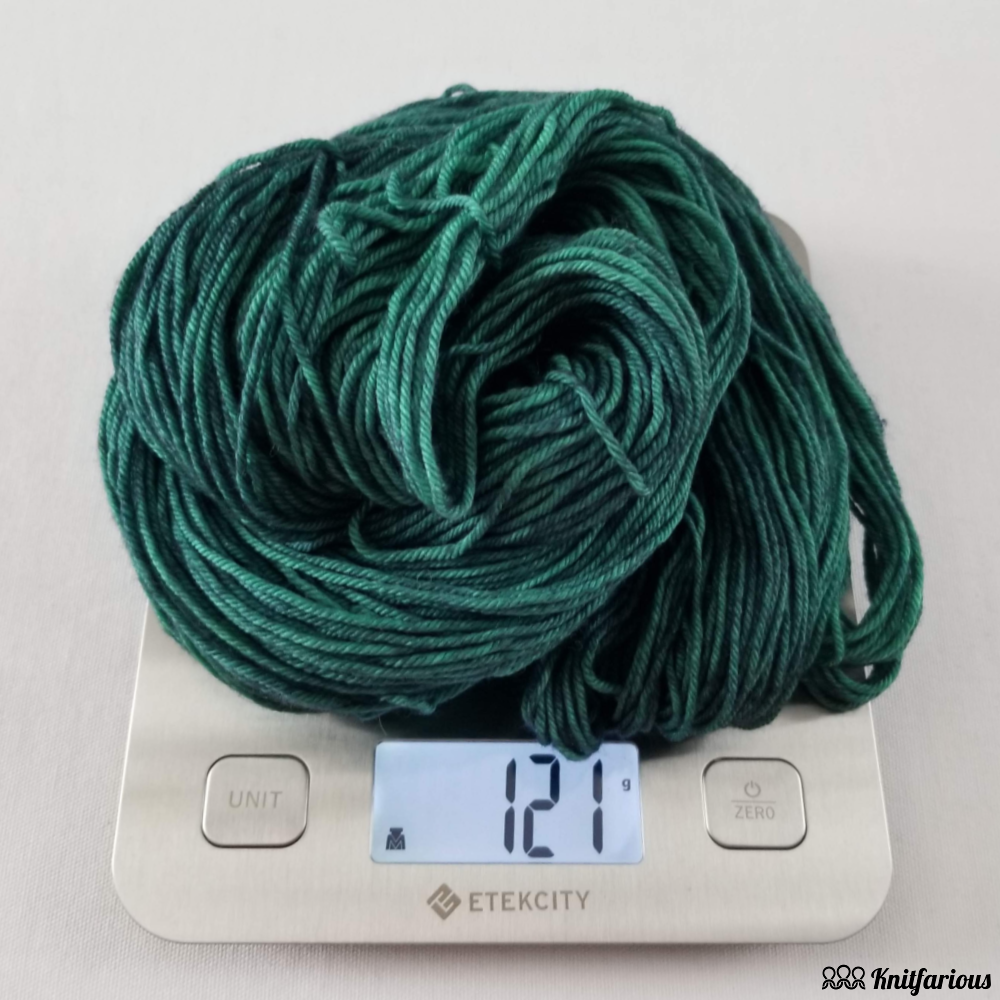
Place your yarn on the scale and weigh it. As you can see, mine weighs 121 total grams, which means I have a little extra yarn in this hank. We’ll call this result “A”.
Weight of yarn in grams = A
Ex. 121 grams (shown above)
Look up the type of yarn you’re weighing and jot down what a standard skein weighs in grams, and the amount of yards/meters in one full skein of yarn. Wayback Yarns DK 250 SW has 250 yards (228 meters) and weighs 4.1 ounces / s115 grams.
Example yarn = 250 yards (229 m) and 115 grams
Next, divide the number of yards or meters by the number of grams. Let’s call this result “B”.
Divide # of yards/meters by # of grams = B
250 yards divided by 115 grams = 2.17
229 meters divided by 115 grams = 1.99
Now, multiply A and B together to determine “C”.
Formula = A X B = C
121 X 2.17 = C
121 X 1.99 = C
Here, C equals 263 yards or 241 meters, which is the approximate yardage/meterage in the hank of yarn in our example.
121 X 2.17 = 263 yards (approximate)
121 X 1.99 = 241 meters (approximate)
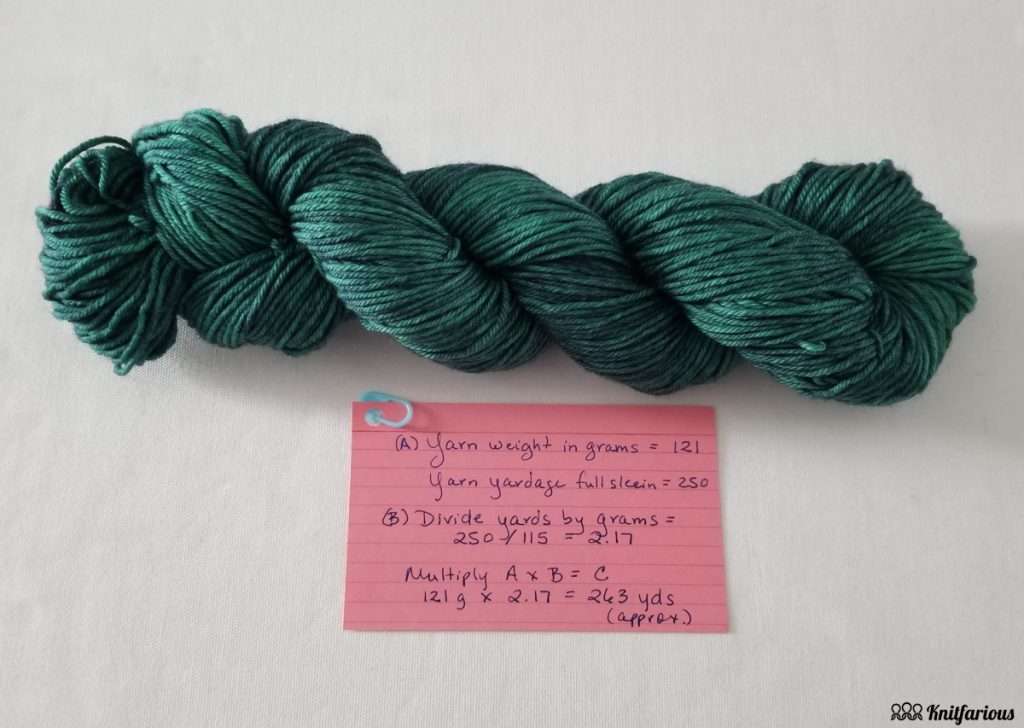
After you’ve finished your calculations, write everything down on your index card. Again, punch a hole and clip it to the yarn with a stitch marker for future reference.
Whether you knit or crochet, you’ve just learned two ways to determine yarn yardage calculations. These methods will help you determine the remaining weight of your yarn, which is a time saver!
I hope you enjoyed these tips and apply them to calculating yarn for your next project. Did you love this tutorial? Still have questions? Leave me a comment below.


